OSTEOARTHRITIS
Background
Osteoarthritis is one of the vaguest terms in the medical nomenclature and refers to the loss of cartilage of any joint. It is a degenerative process that is not linked to any specific pathology in idiopathic cases. Principally, loss of cartilage in any joint is a common process that happens for most human beings, slowly but surely at different rates from the age of 50. There is however one exception to the rule, and that is in patients with traumatic injuries with cartilage damage and this is referred to as secondary osteoarthritis.
Principally, osteoarthritis then refers to a process where the smooth cartilage surface of the joint is slowly eroded. Cartilage creates a polished gliding surface between the bones. There is no nerve supply to this low resistant specialised tissue and any movement in the joint is not felt. However, once this is worn away and the two bone surfaces are in contact with each other, the patient becomes aware of pain in their joints.
What causes pain in Osteoarthritis?
The subchondral area of the bones has a very well innervated nerve supply and therefore, when the bones are “kissing” each other, as opposed to having cartilage between them, pain is generated. This creates secondary inflammation inside the joint called synovitis, causing swelling and pain in the joint. When this process is prolonged, secondary changes occur in the joint with osteophytes or bone spurs forming, and sometimes even loose bodies of bone can form. This is typically associated with swelling, pain and stiffness in the joint.
Conservative Treatment
If we consider the pathology of osteoarthritis, the degenerative process of losing the cartilage between the joints, resulting in bone-on-bone contact, and causing secondary synovitis, the initial treatment is always a conservative approach to see if a few minimal changes can make difference. For example, immobilizing a joint for a short period of time can achieve relief for many patients.
Typically, we refer these patients to a hand therapist who carefully fabricates a hand splint to immobilize and rest the painful joint. This also achieves an awareness of the painful joint and restricts the patient from overusing it. As osteoarthritis has an inflammatory process that creates pain, swelling and stiffness of a joint, a short course of anti-inflammatories can bring great relief for some patients, especially in the early phase of osteoarthritis.
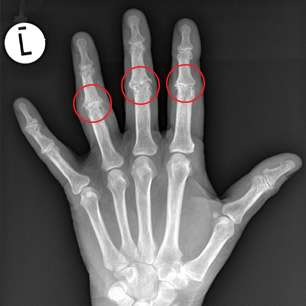
It is of great value for a patient to understand that they have osteoarthritis and for a clinical diagnosis to be made so that they can view the x-rays, and see that the joint space has narrowed. It is therefore imperative that patients modify their activities, preventing movements that are likely to create pain and discomfort. The hand therapists can guide patients on activity modification, helping to facilitate function and limit pain.
Principles of surgical treatment
Treating osteoarthritis is based on two treatment options. Firstly, if we stop the movement that creates pain, a fusion can be created. A fusion makes the joint stiff or another name for this is an arthrodesis. In hand surgery, an arthrodesis or a limited arthrodesis is an excellent treatment option in some of the osteoarthritic conditions of the wrist and especially for the last joints of the fingers called the DIP joints.
The idea of removing the bone-on-bone contact is also the principle which hip and knee total joint replacements are based on. Changing the bone surface to an artificial prosthesis, means the bone-on-bone contact is eliminated, taking the pain away but also maintaining movement. This is first prize in the management of osteoarthritis - restoring movement and removing pain.
In the wrist and the hand joints we have seen significant improvement in this journey (over the last couple of years) and therefore total joint replacements have made a significant breakthrough for patients who had chronic years of pain. In the hand, the wrist joint can be replaced, the base of thumb joint can be replaced and some of the knuckle joints and the proximal interphalangeal joints can be replaced with replacements. Depending on the type of joint, there are a few different types of prostheses available
We have therefore seen significant improvements over the last 15 years in the journey of the treatment of wrist and hand osteoarthritis with the breakthrough of joint replacements for the wrist joint, base of thumb joint, knuckle joints and proximal interphalangeal joints.